The Exhausting Limits of the Mind's Eye
You have spent the last three hours deep inside a meticulously crafted scenario. The world-building is flawless, the dialogue is razor-sharp, and your digital companion feels incredibly lifelike. You are entirely immersed in a text-based roleplaying session on platforms like Janitor AI or Character.AI. But then, a subtle friction begins to build. The AI describes your companion glaring at you from across a dimly lit tavern, wearing a crimson cloak. A few messages later, the AI forgets the setting, the cloak becomes a blue tunic, and you are forced to mentally rewrite the scene. Relying purely on the theater of the mind is a powerful exercise in imagination, but it can also be incredibly exhausting. When you are deeply invested in a narrative, you do not just want to read about a character's micro-expressions or the neon-drenched alleyway they are standing in—you want to see it. You want the visceral, immediate emotional impact of looking your companion in the eyes.
The Bottleneck of Pure Text Chatbots
For years, text-based AI chatbots have been the undisputed kings of digital roleplay. They offer infinite possibilities, allowing users to step into the shoes of intergalactic explorers, fantasy heroes, or modern-day detectives. However, pure text chatbots suffer from an inherent limitation: the cognitive load is entirely on the user. The AI provides the script, but your brain has to act as the director, the set designer, the lighting crew, and the costume department. This leads to a common problem known in the roleplay community as narrative drift. Without a visual anchor, text models often hallucinate physical traits, forget spatial relationships, and lose track of the environment. The illusion shatters the moment you have to remind the AI that you are inside a moving train, not a forest. The desire for a more anchored, immersive experience has paved the way for a massive paradigm shift in the community: the rise of visual AI roleplay.
What is Visual AI Roleplay?
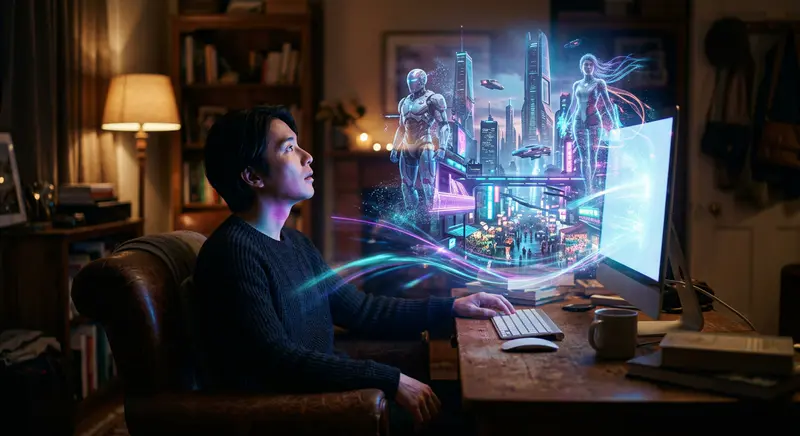
Visual AI roleplay bridges the gap between interactive fiction and generative digital art. Instead of simply generating a wall of text in response to your actions, the AI simultaneously generates dynamic visual representations of the scene, the characters, and their actions. It is a multi-modal approach to storytelling. When you type that you are drawing your sword and stepping into the light, the system does not just describe the glint of the steel; it shows you the character's reaction, the shifting shadows, and the exact atmosphere of the moment. This is not just about slapping a static avatar next to a chatbox. True visual AI roleplay is fluid and responsive, adapting the imagery to match the evolving emotional tone and physical environment of the narrative. It transforms reading a book into playing a customized, infinitely branching video game.
The Holy Grail: Consistency in Faces, Clothing, and Scenes
As exciting as visual generation sounds, early attempts at combining images with AI chat were plagued by a massive technical hurdle: consistency. In standard image generation, every new prompt is a roll of the dice. A character might look like a rugged mercenary in one image, but in the next, their facial structure changes, their scars move to the other side of their face, and their carefully chosen armor morphs into generic clothing. For roleplayers, this lack of consistency is a fatal flaw. Empathy and connection require a stable identity. You cannot form a bond with a character if they look like a completely different person every time the scene updates. The true holy grail of visual AI roleplay is maintaining strict consistency across three pillars: facial identity, wardrobe, and environment. A successful system must understand that if a character puts on a specific necklace in chapter one, that necklace needs to remain visible in chapter five. It must recognize that a dimly lit cyberpunk apartment should retain its layout and lighting even as the camera angle changes.

Enter PopVid.ai: Playing a AAA Visual Novel
This is where the landscape of digital storytelling is rapidly changing, and platforms like PopVid.ai are at the forefront of this revolution. PopVid.ai tackles the consistency problem head-on, offering a visual AI roleplay experience that feels less like a chat interface and more like a high-budget, AAA visual novel. By leveraging advanced dynamic visual generation, PopVid.ai ensures that your digital companions retain their unique facial features, their specific outfits, and their distinct environments throughout the entire campaign. Imagine running a sci-fi tabletop campaign where, instead of just reading text, you are greeted with cinematic, beautifully rendered scenes. When your character smiles, you see the genuine warmth in their meticulously rendered eyes. When the scene transitions from a sunlit meadow to a dark cavern, the lighting on your character's face shifts realistically. PopVid.ai takes the heavy lifting off your imagination, allowing you to simply fall into the story.
Why Visuals Deepen Narrative Immersion
The transition from text to visual roleplay is not just a technological upgrade; it is a psychological one. Human beings are inherently visual creatures. We are hardwired to process body language, facial expressions, and environmental cues faster than we process written language. Here is why adding a visual layer elevates the experience:
- Emotional Resonance: Seeing a tear roll down a character's cheek or catching a subtle, playful smirk carries an emotional weight that words often struggle to convey.
- Environmental Atmosphere: Visuals instantly establish the mood. The cold, sterile blue lights of a spaceship or the warm, flickering firelight of a medieval hearth instantly transport you into the scene.
- Reduced Cognitive Load: Because the AI is handling the visualization, you can focus entirely on the dialogue, your choices, and the narrative progression. You are no longer fighting to keep the details straight in your head.
- Pacing and Timing: Visual novels use imagery to control the pacing of a story. A sudden change in character expression or a dramatic shift in background lighting can create genuine suspense or surprise.
The Next Evolution of Storytelling
We are witnessing the end of the era where AI roleplay is confined to scrolling walls of text. The future of interactive storytelling is undeniably multi-modal. While text chatbots like Janitor AI laid the vital groundwork for complex character interactions and infinite narrative branching, visual AI roleplay represents the ultimate realization of those early dreams. It combines the limitless imagination of AI text generation with the breathtaking artistry of modern image rendering. As technology continues to evolve, the line between playing a video game, reading a book, and chatting with an AI will blur entirely. For creators, writers, and roleplayers looking to elevate their narratives, embracing visual consistency and dynamic scene generation is the next logical step. Platforms like PopVid.ai are not just changing how we chat with AI; they are fundamentally redefining how we experience stories, turning every user into the protagonist of their own visually stunning epic.