The Struggle of AI Combat: Why Does It Always Feel the Same?
If you have been participating in AI roleplay communities on platforms like Reddit, you have likely encountered a very specific, highly frustrating scenario. You spend days building the narrative. Your character and the antagonist finally meet in a rain-soaked courtyard. Weapons are drawn. The tension is palpable. You type your opening attack, expecting an epic, cinematic response. Instead, the AI replies with a bland, generic action like 'He dodged your attack and punched you hard, ending the fight.' Or worse, the AI hallucinates completely. It forgets who is holding the sword, suddenly makes your heavily armored knight perform an impossible triple-backflip, or instantly heals a wound your character suffered just two turns ago.
Writing compelling, logical fight scenes in AI roleplay is notoriously difficult. Large language models are trained on vast amounts of text, which means they often default to repetitive tropes or lose track of the physical space during fast-paced, multi-turn exchanges. They want to resolve the conflict quickly because narrative resolution is a common pattern in their training data. But you do not want a quick summary; you want a battle. You want the clash of steel, the desperate dodges, and the strategic maneuvering. Do not let AI limitations ruin your immersion. In this comprehensive guide, we will explore exactly how to write fight scenes in AI roleplay, stop the frustrating hallucinations, and guide your AI to generate dynamic, edge-of-your-seat combat.
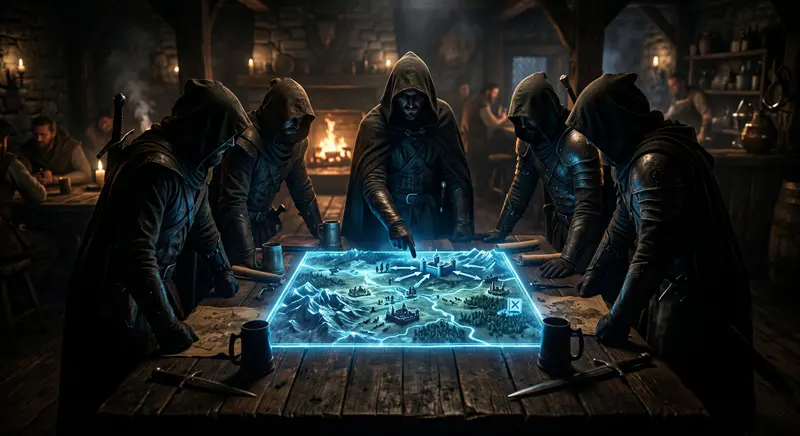
1. Establish Strict Spatial Awareness and Constraints
AI does not have eyes; it only possesses the context you provide through text. When a fight breaks out, the very first thing an AI tends to lose track of is spatial logic. Characters will seemingly teleport across giant rooms, grab weapons that were never explicitly in the scene, or attack from physically impossible angles. To fix this, your prompt needs to clearly establish the 'arena' before the first blow is even struck.
Describe the terrain, the distance between characters, the lighting, and what weapons are currently drawn. By explicitly stating these physical facts, you anchor the AI's generation in a realistic space. For example, instead of writing a simple action like 'I attack him,' you should write: 'I am standing ten feet away in the narrow, muddy alley. Holding my dagger in my right hand, I lunge forward, aiming a quick slash at his left shoulder, being careful not to slip in the slick mud.' This gives the AI a rigid physical framework. It now knows the exact distance, the weapon in play, the specific target of your attack, and an environmental hazard. When the AI formulates its response, it is forced to factor in the mud and the specific angle of your dagger, leading to a much more realistic and grounded counter-attack.
2. Control the Pacing with Micro-Actions
A common mistake roleplayers make is trying to resolve far too much action in a single prompt. If you give the AI a massive paragraph detailing a five-move combo, the AI will likely get confused by the sequence of events. It will summarize the impact, ignore your defensive maneuvers, and spit out a rushed conclusion that skips the gritty details of the fight.
Combat in roleplay is all about pacing. Guide your AI to take it one strike at a time. Encourage 'blow-by-blow' roleplay. You should act, wait for the reaction, and then react to their counter. To enforce this, you can add a system note or OOC (Out of Character) instruction at the end of your prompt: '(OOC: Please respond only to this single strike. Do not auto-hit or resolve the attack for me. Focus on your character's immediate defensive reaction and a single counter-attack.)' This technique prevents the AI from hijacking your character's agency—commonly known as 'god-moding'—and ensures the fight feels like a tense, interactive dance rather than a pre-written movie script where you are just a spectator.

3. Focus on Sensory Details and Real Consequences
AI loves to make characters invincible or have them shrug off mortal wounds because generic action tropes often ignore pain to push the plot forward. To make your fight scenes truly epic and grounded, you need to emphasize consequences. Describe the sting of a graze, the exhaustion setting into your character's muscles, the heavy, ragged breathing, and the metallic smell of blood in the air.
When you focus on the visceral, sensory elements of a fight, the AI will mirror that gritty tone. If you write your character struggling to hold their shield up because of fatigue, the AI is more likely to write a realistic, opportunistic opponent rather than a generic anime villain. Furthermore, make sure to consistently remind the AI of existing injuries. 'Despite the deep gash on my left thigh from your previous strike, I grit my teeth, shift my weight to my right leg, and raise my shield to block.' This forces the AI to acknowledge narrative continuity. Injuries must matter, and by writing the pain into your prompts, you teach the AI that this fight has real stakes.
4. Overcoming Hallucinations with PopVid.ai's Logical Continuity
While prompt engineering is crucial, the platform you choose to host your roleplay makes a massive difference in combat scenarios. The primary reason AI hallucinates during combat—forgetting dropped weapons, swapping character positions, or ignoring established rules—is due to poor context window management. When the battle gets heated and the token count rises over multiple turns, lesser models simply drop the earliest details of the fight to save memory.
This is where PopVid.ai truly shines for AI roleplayers. PopVid.ai is built with exceptionally strong context logic processing, meaning it retains the intricate details of your combat scenario over much longer and more complex exchanges. If you successfully disarmed your opponent three turns ago, PopVid.ai remembers they are unarmed and will generate their responses accordingly—perhaps forcing them to scramble for a makeshift weapon rather than magically producing a new sword. If the fight is taking place on a crumbling, wooden bridge, PopVid.ai keeps that environmental hazard in play, naturally weaving the tension of the collapsing structure into its responses without you needing to constantly remind it in every single prompt.
This advanced logical continuity eliminates the dreaded 'generic trope' problem. By maintaining a deep understanding of the physical space, character inventory, and injury status, PopVid.ai allows for highly strategic, deeply immersive action scenes that feel cohesive from the very first punch to the final, exhausting blow. You can focus on the storytelling and the tactics, trusting the AI to handle the physics and memory.
5. Prompt Templates to Upgrade Your Next Session
To get you started on your journey to better combat, here are a few actionable prompt structures you can use to immediately improve your AI fight scenes. Feel free to adapt these to your specific setting, whether it is high fantasy, cyberpunk, or modern realism.
- The Combat Setup Prompt: Use this when initiating a fight. '(OOC: We are entering a detailed combat scene. The environment is [describe environment in detail]. My character is equipped with [weapons/armor] and your character has [weapons/armor]. Please maintain strict physical logic. Do not auto-hit my character or control my actions. Describe your character's defensive actions and limit yourself to one counter-attack per turn. Keep the pacing slow, gritty, and detailed.)'
- The Mid-Fight Correction: If the AI hallucinates, do not just roll with it or let it ruin the immersion. Correct it firmly using an Out of Character note. '(OOC: Reminder that your character dropped their sword in the previous turn, and my character is currently standing behind cover. Please rewrite your response keeping these physical limitations and positions in mind.)' By taking control of the narrative constraints, you actively train the AI to respect the boundaries of the scene.
- The Sensory Prompt: 'I swing my broadsword in a wide arc. (OOC: Please describe the physical toll this fight is taking on your character. Include sensory details like sweat, breathing, and the physical weight of their weapons. Respond to my swing with a focus on realism.)'
Conclusion: Forge Your Epic Showdown
Writing epic fight scenes in AI roleplay does not have to be an exercise in frustration or a battle against AI memory loss. By managing spatial awareness, slowing down the pacing to a blow-by-blow exchange, emphasizing sensory consequences, and using powerful OOC guidelines, you can transform generic, repetitive scuffles into breathtaking, cinematic showdowns.
And when you pair these advanced prompting techniques with a platform like PopVid.ai, which excels at maintaining logical continuity and processing deep context, you unlock a whole new level of interactive storytelling. Your battles will no longer be derailed by immersion-breaking hallucinations or lazy tropes. Instead, every swing of the sword, every pull of the trigger, and every desperate dodge will carry real, heart-pounding weight. Jump into your next session, apply these strategies, and prepare for the most thrilling, logically sound combat your AI roleplay has ever seen.