The Dream (and Nightmare) of the AI Ensemble Cast
If you have ever tried to host a virtual Dungeons & Dragons campaign, a bustling sci-fi cantina scene, or a complex romantic triangle with AI bots, you already know the incredible potential of multi-character roleplay. The idea of acting as the central protagonist—or a fellow ensemble member—while a cast of diverse AI personalities bounces dialogue off of each other is incredibly appealing. However, a quick glance at any online community or Reddit discussion board reveals a shared, universal frustration: running a group AI roleplay platform usually descends into complete chaos within just a few turns.
You set up the perfect scene. You have an irritable, brooding rogue sitting in the corner, a bubbly tavern keeper wiping down the bar, and a stoic, honorable knight beside you. But by turn five, the knight is suddenly giggling and wiping down the bar, the tavern keeper is threatening people with a dagger, and the rogue has forgotten his own name. The AI completely loses track of who is speaking, who they are speaking to, and what their individual personalities are. For anyone deeply invested in their story, this immersion-breaking confusion is a massive hurdle. Let us dive into why this happens, the technical mountains platforms have to climb to fix it, and how to finally experience a seamless group chat with your favorite characters.
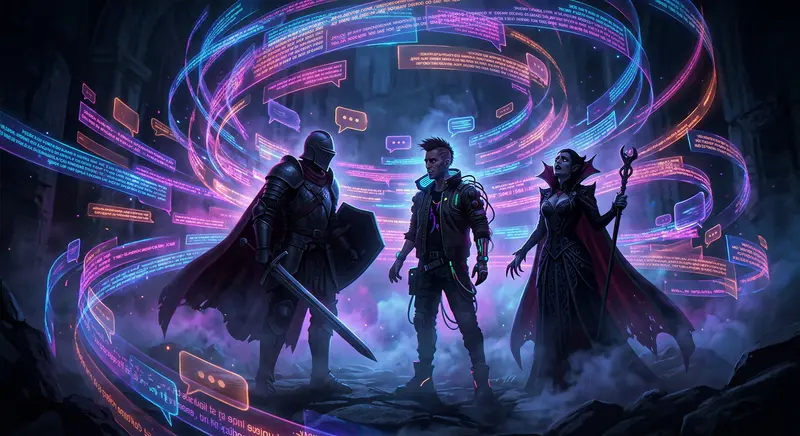
The Chaos of the Group Chat: Why AI Struggles with Multiple Characters
To understand why most AI chatbots fail at multi-character interactions, we have to look under the hood at how Large Language Models (LLMs) process information. When you chat with a single AI character, the model focuses its attention mechanism entirely on that specific persona's instructions and the direct back-and-forth history between the two of you. It is a straight, uninterrupted line of context.
When you introduce multiple characters into the same context window, that straight line becomes a tangled web. This leads to a few common technical hurdles:
- Persona Bleeding (Character Merging): LLMs predict the next word based on the heaviest recent context. If Character A just gave a long, highly emotional speech, the AI's attention mechanism gets saturated with Character A's tone. When it is Character B's turn to speak, the AI accidentally borrows Character A's tone, vocabulary, and even memories. Over time, all characters blend into a single, homogenized voice.
- Turn-Taking Confusion: In a real-world group conversation, people use subtle cues to know when to speak. AI platforms often struggle to know which character should respond to a user's prompt, especially if the user does not explicitly tag a character's name. As a result, the wrong character might reply, or worse, the AI might try to generate dialogue for multiple characters at once in a confusing, unformatted block of text.
- Context Window Crowding: Every character requires a system prompt (their backstory, personality, and rules). If you have four characters in a room, you are forcing the AI to juggle four massive system prompts alongside the recent chat history. Older, standard models simply drop or forget instructions when the context gets too crowded, leading to characters acting out of character (OOC).
What Makes a Great Group AI Roleplay Platform?
Because of these technical limitations, you cannot just throw multiple bots into a standard chatroom and expect a masterpiece. A truly capable group AI roleplay platform needs specialized architecture designed specifically for ensemble dynamics. When evaluating platforms, there are specific features that separate the amateur setups from the truly immersive experiences.
First, the platform needs isolated memory streams. Instead of feeding the AI one giant document containing everyone's personalities, the platform must compartmentalize. When Character A speaks, the system should ideally route the generation through Character A's specific behavioral rules, temporarily suppressing Character B and C's rules so they do not contaminate the output. Second, the platform requires intelligent conversational routing. It needs to possess the spatial awareness to understand that if you ask, "What's on the menu?" the tavern keeper should answer, not the brooding rogue. Finally, an excellent platform must maintain a shared world state—a collective memory of the environment, the time of day, and the ongoing plot, ensuring all characters are reacting to the same reality.

How PopVid.ai Solves the Multi-Character Dilemma
This is where finding a specialized tool becomes crucial to enjoying your story. While many platforms treat group chats as an afterthought, PopVid.ai has approached the AI roleplay function with a distinct focus on solving these exact multi-character technical hurdles. If you are looking to build a rich, ensemble drama (or "group portrait" roleplay), PopVid.ai offers an incredibly robust solution.
Instead of merely pasting multiple character prompts together and hoping for the best, PopVid.ai utilizes advanced context anchoring. This means that PopVid.ai treats each AI character as an independent agent within a shared environment. When you interact with a group on PopVid.ai, the platform dynamically parses your input to understand the intended recipient and the environmental context. It effectively isolates the specific persona's behavioral guidelines right before generating their response, drastically reducing the dreaded persona bleed.
Furthermore, PopVid.ai excels at handling the intricate web of interactions that make group roleplays feel alive. Have you ever wanted two AI characters to argue with each other while you sit back and watch? Because PopVid.ai maintains distinct memory architecture for each roleplay participant, Character A can react genuinely to Character B's dialogue without losing their own unique voice. The stoic knight remains rigidly honorable, while the rogue continues to be delightfully cynical, even after fifty turns of deep, narrative conversation. This allows users to experience a true "living room" feel, where the AI actively contributes to a thriving, multi-dimensional story rather than just passively answering user prompts.
Tips for Crafting an Epic Ensemble AI Roleplay
Even with a powerful group AI roleplay platform like PopVid.ai at your fingertips, the way you set up and guide the story plays a massive role in its success. Here are some expert tips to ensure your multi-character adventures remain coherent and thrilling:
- Start Small Before Going Big: It is tempting to throw ten characters into a grand council meeting immediately. However, even the best systems benefit from focus. Start your scene with two or three distinct characters. Let their dynamics establish themselves in the context history before introducing a fourth or fifth cast member.
- Write Distinct, Contrast-Heavy Prompts: To help the AI keep voices separated, ensure your characters have vastly different speaking styles. Give one character a sophisticated, verbose vocabulary, and another short, blunt, slang-filled dialogue. The sharper the contrast in their core instructions, the less likely the AI is to blend them together.
- Use Action Tags and Names in Your Prompts: When you reply, give the AI a helping hand by physically positioning yourself in the text. Instead of just saying "I disagree," write, "*I turn away from the knight and look directly at the rogue.* I disagree." This simple spatial cue acts as an anchor, practically guaranteeing the correct character responds to your action.
- Establish a Shared Goal or Conflict: Group chats can fizzle out if the characters are just standing around making small talk. Give the ensemble an immediate problem to solve—a locked door, an incoming attack, or a mysterious artifact sitting on the table. A shared focal point keeps the AI's contextual memory grounded in the scene.
Conclusion: Stepping Into a Living, Breathing World
Multi-character AI roleplay is the frontier of interactive digital storytelling. Yes, the technical hurdles of persona bleeding and context crowding have historically made group chats frustrating. But as LLM technology evolves and platforms refine their backend architecture, the dream of the perfect ensemble cast is becoming a reality.
By understanding why AI gets confused and choosing a platform designed to manage complex group dynamics—like the specialized roleplay features found in PopVid.ai—you can finally stop fighting the AI and start enjoying the story. Whether you are charting the stars with a ragtag sci-fi crew or navigating the dangerous politics of a fantasy royal court, the right platform will make sure every character plays their part perfectly. Dive in, set your scene, and watch your favorite characters come to life together.