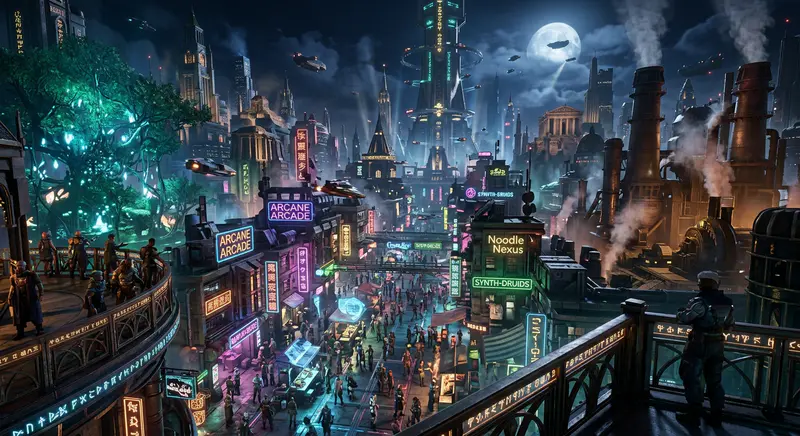
If you have spent any time in the modern AI roleplay scene, you know the familiar feeling of hitting a creative wall. You craft a compelling starting scenario, introduce your character, and begin a fascinating dialogue with an AI companion. For the first twenty messages, the immersion is absolutely incredible. But soon, the illusion begins to crack. The AI focuses entirely on you, completely forgetting the bustling sci-fi cantina or crowded medieval tavern around you. It agrees with everything you say, waiting passively for you to drive the plot forward. The world feels empty, much like a stage play where only two actors showed up, and the background is just a flat, painted canvas. This is the inherent limitation of the standard one-on-one AI chatbot. However, a massive shift is happening in the digital storytelling community. We are witnessing the rise of the AI text RPG sandbox—a dynamic, multi-character ecosystem where you are not just talking to a bot, but actively living inside a breathing, unpredictable world.
The Problem with Traditional 1-on-1 AI Chatbots
To understand why the AI text RPG sandbox is such a revolutionary leap forward, we first need to look at why traditional 1-on-1 AI chats eventually lose their magic. Most early AI roleplay platforms were designed with a singular goal: simulate a conversation with one specific persona. While this is great for simple character interactions, it fails miserably when trying to emulate the depth of a true roleplaying game.
First, there is the issue of the vacuum effect. In a standard chatbot environment, nothing exists outside of your immediate conversation. If you and the AI are talking in a forest, there are no unseen wolves stalking you, no weather changes, and no other travelers passing by unless you explicitly tell the AI they are there. The burden of generating the entire world falls entirely on your shoulders, which quickly leads to creative burnout.
Second, traditional bots suffer from the yes-man syndrome. Because they are programmed to be helpful conversational assistants at their core, they tend to agree with whatever the user says. If you say you easily defeat the invincible dragon, the AI will likely congratulate you. There is no friction, no challenge, and consequently, no real sense of achievement or narrative tension.
Finally, there is the lack of multi-character dynamics. A true RPG experience relies on a colorful cast of NPCs who have their own agendas, rivalries, and relationships. Standard chatbots struggle to juggle more than one persona, often blending voices together or completely forgetting that a third character is in the room.
What is an AI Text RPG Sandbox?
An AI text RPG sandbox completely flips the script. Instead of prompting the AI to act as a single character, you prompt the AI to act as an entire world engine. Think of it as transitioning from talking to a solitary NPC to having a dedicated AI Dungeon Master who controls the environment, the weather, the pacing, and a multitude of characters simultaneously.
In a sandbox environment, the focus shifts from a linear conversation to emergent gameplay. You are placed in a rich setting with established lore, rules, and factions. The AI does not just respond to what you say; it reacts to what you do, and occasionally, it initiates events without your prompting. A tavern brawl might break out on the other side of the room while you are sipping your drink. A sudden storm might force you to seek shelter. The world moves and breathes independently of your immediate actions, creating a profound sense of immersion that 1-on-1 chatbots simply cannot match.
The Core Elements of a True Sandbox Experience
Building an AI text RPG sandbox requires a different approach to prompting and platform usage. To create a world that feels genuinely alive, a few core elements must be seamlessly integrated into your roleplay sessions.
- Rich Environmental Storytelling: The AI must be instructed to constantly describe the sensory details of the environment. The smell of ozone in a cyberpunk alleyway, the sound of distant war horns, or the subtle shifting of shadows. The environment should act as a silent, ever-present character in your story.
- Autonomous Multi-Character Interactions: The truest test of a sandbox is whether NPCs interact with each other, not just with you. The AI needs the capability to manage side conversations, arguments between party members, and shifting alliances that happen dynamically in the background.
- Consistent World Rules and Lore: A sandbox needs boundaries to feel real. If magic requires a physical toll in your world, the AI must enforce that rule. If a certain city is hostile to outsiders, the AI must ensure the town guards treat you with appropriate suspicion. Consistency transforms a random text generator into a persistent reality.
- Consequences and Player Agency: In a sandbox, your choices must matter. If you insult a local lord, you should face assassination attempts later in the story. The AI must be capable of tracking long-term consequences and weaving them organically into future events.

Shifting Your Mindset: From Chatting to World-Building
To successfully dive into an AI text RPG sandbox, you have to change how you write your starting prompts. Instead of simply detailing a character's physical appearance and personality, you must outline the logic of the world. You are writing a system manual.
A strong sandbox prompt includes a World State, detailing the current political or social climate. It includes Factions, giving the AI groups to pull from when generating random encounters. It also includes Directives for the AI, explicitly telling the engine to surprise you, challenge you, and introduce sudden complications.
For example, instead of writing: You are an elven ranger named Elara who is my guide, you would write: You are the Game Master of a dark fantasy world called Aethelgard. You control all NPCs, weather, and random events. Introduce Elara, an elven ranger with a suspicious past, but also manage the rest of the mercenary camp around us. Do not let me succeed easily; enforce the harsh survival rules of this world.
Enter PopVid.ai: Crafting Your Ultimate Sandbox World
While the concept of an AI text RPG sandbox is incredible, executing it requires an AI platform with the technical muscle to handle complex, multi-layered logic without losing context. If you are ready to graduate from simple chatbots to complex RPG sandboxes, having the right platform is critical. This is where PopVid.ai steps in as a highly capable engine for your imagination.
PopVid.ai is uniquely suited for sandbox roleplay because it is designed to support rich scene settings and extensive world-building parameters. Unlike standard chat interfaces that easily forget the rules you set ten messages ago, PopVid.ai allows users to establish deep, persistent system instructions. You can clearly define the overarching lore, the behavioral logic of multiple factions, and the tone of the narrative, ensuring the AI maintains the integrity of your world over long, drawn-out campaigns.
Furthermore, PopVid.ai excels at multi-character interactions. When you step into a crowded royal court or a bustling space station, the platform can adeptly juggle the distinct voices and motivations of various NPCs. It allows your roleplay to feel less like a solitary chat log and much more like a dynamic, interactive RPG game where the world reacts to your presence in real-time. By providing the tools necessary to maintain complex narrative threads, PopVid.ai empowers creators and players to build sandboxes that are genuinely surprising, endlessly replayable, and deeply immersive.
Why Sandbox Roleplay is the Future of Digital Storytelling
The evolution from 1-on-1 chatbots to the AI text RPG sandbox represents a maturation of the medium. We are moving past the novelty of simply having a computer talk back to us. Now, we are demanding entire universes to explore, filled with danger, mystery, and spontaneous joy.
By embracing sandbox mechanics, you unlock infinite replayability. No two sessions will ever be the same, because the AI is constantly generating new variables and reacting to your unique choices. As platforms like PopVid.ai continue to refine their ability to process complex world-building prompts, the barrier between traditional tabletop RPGs, video games, and AI text roleplay will continue to blur. The future of interactive fiction is not just about who you are talking to—it is about the vast, unpredictable worlds you are brave enough to step into.