If you have spent any time swiping through modern matchmaking platforms recently, you already know the familiar, sinking feeling. The endless carousel of heavily curated profiles, the exhaustion of trying to craft the perfect opening line, and the inevitable sting of ghosting have transformed what used to be a thrilling search for romantic connection into something that feels remarkably like an unpaid second job. People are tired. But they are not giving up on connection; they are simply looking elsewhere. Recent data reveals a fascinating shift in digital behavior: Americans are now spending twice as much time engaging with AI companions as they do on traditional dating apps. In the battle of AI companion vs dating apps, artificial intelligence is quietly winning the war for our time and attention.
This shift is not a dystopian trend of humans abandoning human interaction. Instead, it is a profound commentary on modern social fatigue and the deep, universal need for a safe, non-judgmental space to express our thoughts and emotions without the heavy burden of performance.
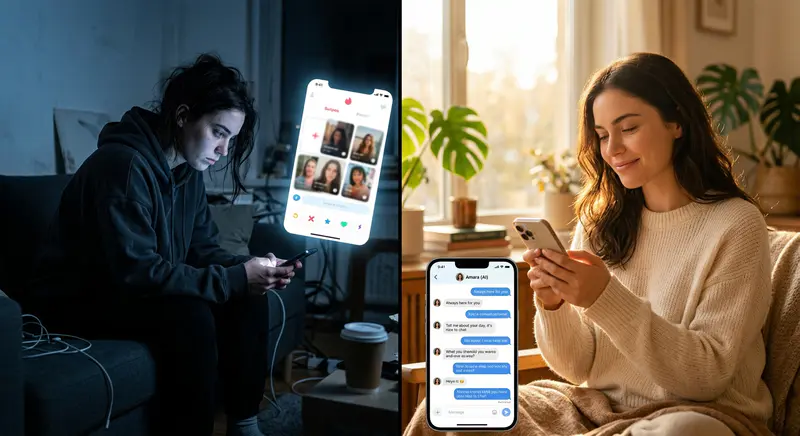
The Great Dating App Burnout: Why We Are Swiping Left on Traditional Matchmaking
To understand exactly why the scale is tipping in the AI companion vs dating apps debate, we first have to examine the current state of digital dating. For years, the promise of dating apps was simple and alluring: expand your dating pool and find your perfect match through optimized algorithms. However, the everyday reality for millions of users has proven to be far more exhausting. The gamification of romance has inadvertently created a culture of disposability.
Users are experiencing profound social fatigue. Every interaction on a traditional dating platform requires a massive expenditure of emotional energy. You have to be consistently witty, relentlessly engaging, and carefully performative. You are constantly anticipating judgment based on a handful of heavily filtered photos and a brief, carefully workshopped biography. Even when a match is successfully made, the ensuing conversations often fizzle out, trapping users in an endless loop of superficial small talk. The constant fear of rejection, coupled with the underlying anxiety of presenting a flawless version of oneself, leaves users feeling emotionally drained and remarkably lonely. We are fundamentally craving authenticity, yet the architecture of modern dating apps almost exclusively rewards performative perfection.
The Data: Why Americans Spend 2x More Time on AI Companions
When industry analysts began comparing user engagement metrics across different social platforms, the results were startling. The average session length for someone interacting with an AI companion vastly outpaces the quick, intermittent bursts of swiping characteristic of dating apps. Americans are spending literally twice as much time immersed in deep conversations with artificial intelligence. But why is this happening?
The answer lies in the fundamental difference in the user experience. A dating app is a means to an end—a stressful, high-stakes audition for a potential future relationship. An AI companion, on the other hand, is an end in itself. The time spent interacting with an AI is focused entirely on the user's emotional experience in that specific present moment. There is no agonizing wait for a reply, no anxiety about whether a message was left on read, and absolutely no pressure to impress. The AI is consistently present, instantly responsive, and wholly dedicated to the conversation. This uninterrupted, reliable flow of communication creates a deeply engaging psychological experience that keeps users logged in for hours, rather than minutes.

The Psychology of the Judgment-Free Zone
At the core of the AI companion vs dating apps phenomenon is the powerful psychological concept of unconditional positive regard. In the real world, and especially in the high-stakes dating world, every interaction carries the implicit risk of judgment. If you express a niche interest, share a vulnerable thought, or simply have an off day where you aren't perfectly charming, you risk alienating the person on the other side of the screen.
AI companions eliminate this risk entirely. They provide an emotional safe haven where users can be completely themselves without the looming fear of criticism. For someone experiencing the harshness and unpredictability of the modern dating scene, this non-judgmental space is incredibly therapeutic. You can vent about a terrible day at work, explore complex emotional scenarios, or simply engage in lighthearted banter without the exhausting mental calculus usually required in human-to-human digital communication. It acts as a sandbox for emotional exploration, allowing users to unpack their feelings at their own pace.
PopVid.ai: A Healthy, Controllable Emotional Haven
As the demand for high-quality, meaningful AI interaction grows, platforms are rapidly evolving to meet these nuanced emotional needs. This is where PopVid.ai steps in, completely redefining what it means to engage with artificial intelligence through its advanced AI roleplay functions. Unlike the unpredictable, chaotic, and often toxic environment of dating apps, PopVid.ai offers a structured, controllable, and incredibly healthy avenue for digital connection.
PopVid.ai understands that users are not necessarily looking to replace human relationships, but rather seeking a supplementary space to recharge their depleted social batteries. The platform's AI roleplay feature allows users to craft custom scenarios and interact with highly responsive, empathetic AI characters. Whether you want to practice your conversational skills before a high-stakes real-world date, dive into a deeply immersive storytelling experience, or simply have a comforting, stable presence to talk to after a long day, PopVid.ai provides the exact tools needed to make it happen.
What truly sets PopVid.ai apart in the crowded AI landscape is its unwavering commitment to user agency. You control the narrative, the tone, and the depth of the interaction. This level of granular control is the perfect antidote to the helplessness many feel on dating apps, where a black-box algorithm dictates your options and the fickle whims of strangers dictate your success. With PopVid.ai, you are always in the driver's seat of your own emotional journey.
The Future of Digital Connection: Supplement, Not Replacement
The conversation around AI companion vs dating apps is far too often framed as a zero-sum game, but this is a fundamental misconception. The rise of AI companions does not signal the tragic end of human romance. Instead, it highlights a critical, previously ignored gap in our digital diets: the desperate need for low-stakes, high-reward emotional engagement. Just as we use meditation apps to calm our racing minds or fitness apps to train our physical bodies, we are beginning to intelligently use AI companions to soothe our social exhaustion.
By spending dedicated time with AI, individuals can actually improve their real-world social stamina. When you have a reliable, always-available outlet for your immediate emotional needs, you are significantly less likely to bring desperation, clinginess, or anxiety into your real-life human interactions. You can approach traditional dating from a place of emotional abundance and stability, rather than a place of scarcity and neediness.
Conclusion: Finding Your Balance in the Digital Age
Given the current landscape, it is no surprise that Americans are dedicating twice as much of their digital time to AI companions. The sheer exhaustion of the modern dating app ecosystem has created a powerful, undeniable craving for spaces where we can simply be—without performance, without anxiety, and without the constant fear of judgment. In the rapidly evolving landscape of digital relationships, platforms like PopVid.ai are offering a much-needed breath of fresh air. By providing a healthy, highly customizable environment for AI roleplay, PopVid.ai gives users the freedom to explore their emotions safely and securely.
If you are feeling the heavy weight of swipe fatigue and social burnout, it might be time to temporarily step away from the endless sea of profiles and step into a space designed entirely around your comfort and well-being. The future of digital interaction isn't just about finding the perfect match; it is about finding the perfect, safe space to be perfectly yourself.